



Introduction:
Recent data from the American Society of Clinical Oncology (ASCO) GI Cancers Symposium 2025, as detailed in their educational book, provides a comprehensive look at the current state of CAR-T (Chimeric Antigen Receptor T-cell) therapy for gastrointestinal (GI) cancers. Despite the promise of this innovative approach, the results from 17 clinical trials suggest that CAR-T therapy has yet to transform the treatment landscape for these cancers as significantly as hoped. Here, we present an objective analysis based on these findings.
Overview of Trials:
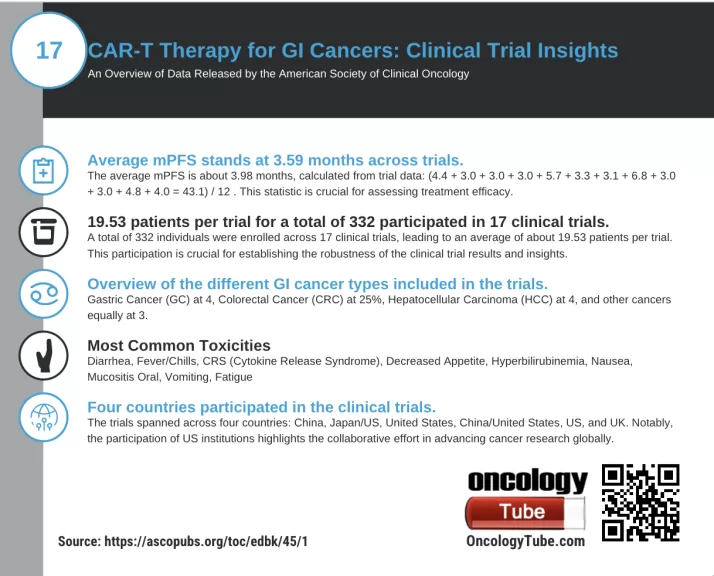
The trials encompassed a variety of GI cancers, including Gastric Cancer (GC), Gastroesophageal Junction Cancer (GEJC), Colorectal Cancer (CRC), Hepatocellular Carcinoma (HCC), Pancreatic Cancer (PC), and Biliary Tract Cancer (BTC). These studies were conducted internationally. Countries like China, the United States, Japan, and the UK participated.
Key Findings:
- Patient Enrollment: Across the 17 trials, a total of 332 patients were involved, averaging approximately 19.53 patients per trial. This figure provides a sense of the scale at which CAR-T therapy is being explored for GI cancers.
- Response Rates: The average Overall Response Rate (ORR) was calculated at 18.97%. Some trials, such as C-CAR031 for HCC targeting GPC3, showed higher ORRs at 56.5%. However, others, particularly those targeting Mesothelin in PC, reported no response.
- Progression-Free Survival (mPFS): The median Progression-Free Survival (mPFS) across these trials, where available, averaged around 3.59 months. This indicates that while there is some benefit, the duration of disease control remains limited. The trial with the highest mPFS was Y035 for HCC at 6.8 months.
- Toxicity Profile: CAR-T therapy has been associated with notable side effects, including high rates of Cytokine Release Syndrome (CRS). Some trials reported up to 97% incidence. Other common side effects included nausea, vomiting, diarrhea, and fever/chills, with varying severity.
Detailed Analysis:
- Gastric and Gastroesophageal Junction Cancers: For instance, the CT041 trial targeting CLDN18.2 had a 39% ORR with a 4.4-month mPFS. It showed moderate efficacy. However, significant side effects like nausea (67%) and CRS (97%) were noted.
- Colorectal Cancer: The IMI6 trial for CRC targeting GUCY2C showed a 26% ORR with a 3.0-month mPFS. This indicates room for improvement in both response and longevity of treatment effect.
- Hepatocellular Carcinoma: Trials like C-CAR031 for HCC showed promising response rates (56.5% ORR). However, the lack of reported mPFS data leaves questions about sustained efficacy.
- Pancreatic Cancer: The trial targeting EGFR in PC had a 28% ORR and a 3.0-month mPFS. Mucositis oral was a common side effect.
- Biliary Tract Cancer: For BTC, the EGFR-targeted trial reported a 6% ORR with a 4.0-month mPFS. This suggests limited effectiveness in this cancer type.
Discussion:
The data from these trials indicate that while CAR-T therapy holds potential, it is not yet the revolutionary treatment for GI cancers that some might expect. The modest response rates and relatively short progression-free survival periods highlight significant toxicity. These challenges hinder making CAR-T a standard of care.
Future Directions:
Ongoing research is essential to enhance the efficacy of CAR-T therapy, extend mPFS, and mitigate toxicity. International collaboration will play a key role in refining this therapy. The goal is to improve patient outcomes without compromising safety.
Conclusion:
The insights from the ASCO GI 2025 trials provide a neutral perspective on CAR-T therapy’s current role in treating GI cancers. While progress is evident, the therapy’s impact has been less transformative than anticipated. This sets the stage for further research and development.
References:
- Data sourced from the ASCO Educational Book Volume 45 Issue 1, presented at the ASCO GI 2025 conference in San Francisco. https://ascopubs.org/toc/edbk/45/1
For more updates on oncology research, consider subscribing to our newsletter or following us on social media. For additional information on these and other cancers, please visit oncology2.com (#).
Tags: #CARTherapy #GICancers #Oncology #GI25 #CancerResearch #MedicalInnovation #PatientCare #ClinicalTrials
Note: This post is for informational purposes only and should not replace professional medical advice. Always consult with a healthcare provider for treatment decisions.
Related Articles: