


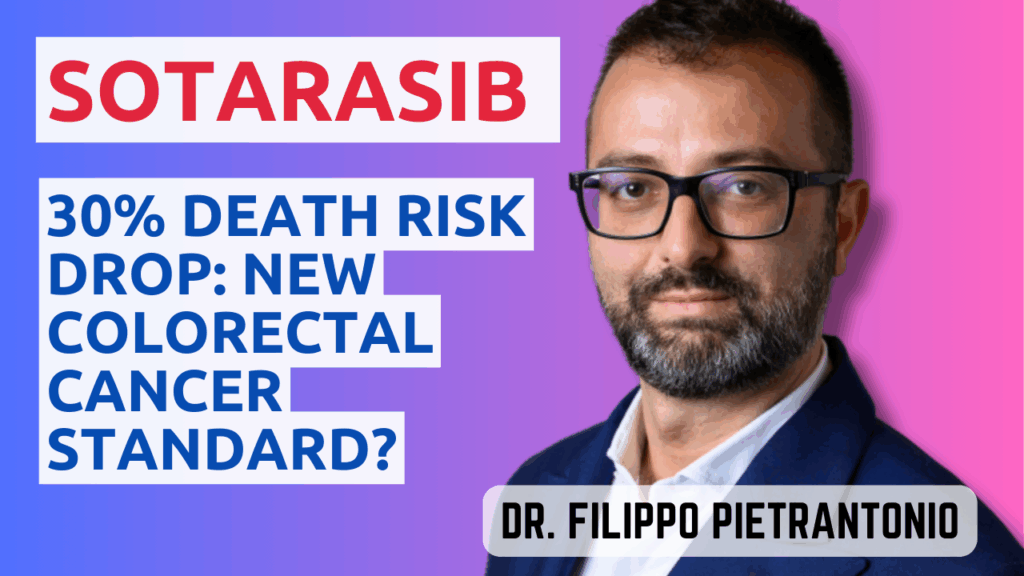
Published: April 21, 2025 | OncologyTube.com
A groundbreaking phase III study, published on April 11, 2025, in the Journal of Clinical Oncology, highlights sotorasib plus panitumumab as a potential new standard of care for chemorefractory KRAS G12C-mutated metastatic colorectal cancer (mCRC). The CodeBreaK 300 trial (DOI: 10.1200/JCO-24-02026) offers critical insights for oncologists and researchers tackling this challenging molecular subtype. Here, we break down the study’s key findings, clinical implications, and future directions.
Overview of the CodeBreaK 300 Trial
The CodeBreaK 300 study, led by Filippo Pietrantonio, MD, and colleagues, evaluated sotorasib, a KRAS G12C inhibitor, combined with panitumumab, an EGFR inhibitor, in 160 patients with chemorefractory KRAS G12C-mutated mCRC. Patients were randomized 1:1:1 to receive sotorasib 960 mg plus panitumumab, sotorasib 240 mg plus panitumumab, or investigator’s choice of trifluridine/tipiracil or regorafenib. The trial, conducted between April 2022 and March 2023, focused on patients naïve to KRAS G12C inhibitors. Participants were within a median age range of 58–65 years.
Primary Endpoint: Progression-Free Survival
The primary analysis previously reported a significant progression-free survival (PFS) benefit for the sotorasib 960 mg-panitumumab arm (5.6 months vs. 2.0 months for investigator’s choice; hazard ratio [HR] 0.48, 95% CI 0.30–0.78, P = .005). This established the combination’s efficacy in delaying disease progression.
Key Findings: Overall Survival and Response Rates
The final analysis, after a median follow-up of 13.6 months and 82 deaths, focused on overall survival (OS), a key secondary endpoint. Key results include:
- Overall Survival: The sotorasib 960 mg-panitumumab arm showed an HR of 0.70 (95% CI 0.41–1.18, P = .20). This suggests a 30% reduced risk of death, though not statistically significant due to limited power. Median OS was not reached in the 960 mg arm, compared to 11.9 months (240 mg arm) and 10.3 months (investigator’s choice).
- Objective Response Rate (ORR): The 960 mg arm achieved a 30.2% ORR (95% CI 18.3–44.3). This is significantly higher than 7.5% (240 mg) and 1.9% (control). The median duration of response was 10.1 months in the 960 mg arm.
- Subgroup Analysis: OS trends were consistent across subgroups, despite small sample sizes in some cohorts.
Notably, 27.8% of control arm patients received subsequent KRAS G12C inhibitors off-protocol. An adjusted analysis accounting for this crossover yielded an HR of 0.65 (95% CI 0.28–1.37) for the 960 mg arm. This reinforces the survival trends.
Safety Profile of Sotorasib Plus Panitumumab
The safety profile was consistent with prior reports, with no new signals. Grade 3 or higher treatment-related adverse events (TRAEs) occurred in 45.3% of patients in the 960 mg arm. These were primarily dermatitis acneiform and hypomagnesemia. By contrast, neutropenia and anemia were more common in the control arm, with TRAEs occurring in 45.1% of patients. Grade 3+ hepatotoxicity was rare at 1.9% in the 960 mg arm.
Clinical Implications for Oncologists
The CodeBreaK 300 results position sotorasib 960 mg plus panitumumab as a high-response treatment option for the ~3–4% of colorectal cancer patients with KRAS G12C mutations. Key takeaways for clinicians:
- Routine Testing: KRAS G12C testing, already standard in mCRC, identifies eligible patients for this targeted therapy.
- Treatment Integration: The combination’s 30.2% ORR and manageable toxicity support its use in chemorefractory settings.
- Patient Benefits: Higher response rates and potential survival gains improve outcomes in a population with limited options.
Research Implications and Future Directions
While the study was not powered for OS, the HR of 0.70 and non-reached median OS in the 960 mg arm are promising. Researchers should focus on:
- Larger Trials: Validate findings in broader populations to confirm OS benefits.
- Combination Therapies: Explore sotorasib-panitumumab with other agents to enhance efficacy.
- Real-World Data: Assess the combination’s impact in diverse clinical settings.
Comparisons to trials like KRYSTAL-1 (adagrasib plus cetuximab) show similar PFS and ORR. However, CodeBreaK 300’s randomized design strengthens its evidence. The study also highlights the challenge of crossover, with 27.8% of control patients accessing KRAS G12C inhibitors. This potentially confounds OS results.
Why This Matters for Colorectal Cancer Care
KRAS G12C-mutated mCRC represents a critical unmet need. Standard therapies like trifluridine/tipiracil or regorafenib yield median OS of 6.4–7.1 months in similar settings. CodeBreaK 300’s 10.3-month median OS in the control arm is likely due to molecular selection and subsequent therapies. This underscores the evolving landscape. The sotorasib 960 mg-panitumumab combination offers a targeted approach, aligning with precision oncology’s promise.
Access the Full Study
For detailed subgroup analyses, safety data, and methodology, read the full study at ascopubs.org. The CodeBreaK 300 trial (NCT05198934) was supported by Amgen Inc., with data presented at ASCO 2024 (Abstract LBA3510).
Call to Action: How will sotorasib plus panitumumab shape your practice? Share your insights in the comments and explore more oncology breakthroughs at OncologyTube.com.
SEO Keywords: CodeBreaK 300, sotorasib, panitumumab, KRAS G12C, colorectal cancer, metastatic colorectal cancer, phase III trial, overall survival, progression-free survival, targeted therapy, precision oncology, Journal of Clinical Oncology.
Tags: Colorectal Cancer, KRAS G12C Mutation, Sotorasib, Panitumumab, Clinical Trial, Oncology Research, Precision Medicine.
Related Articles: