


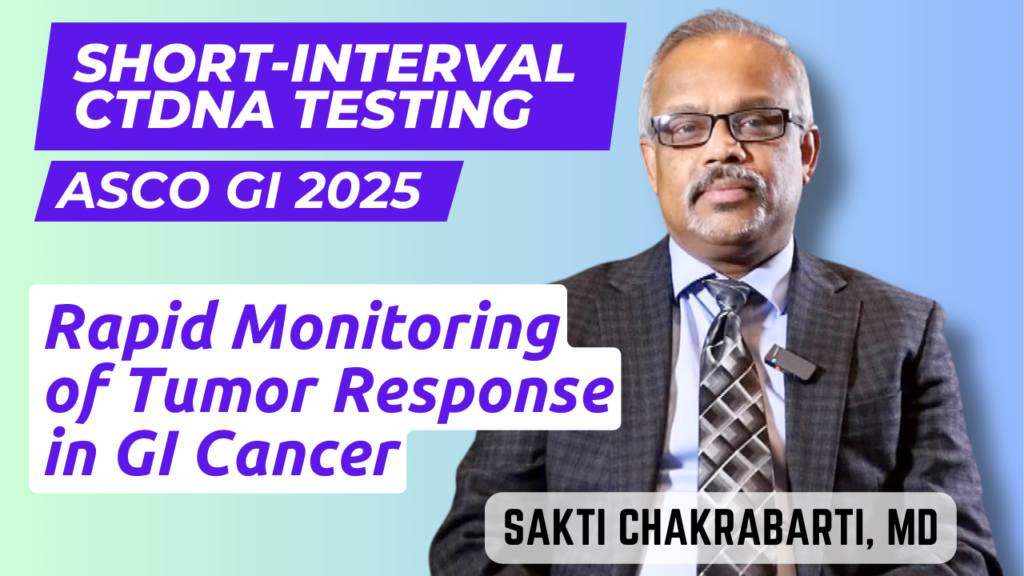
Abstract:
Circulating tumor DNA (ctDNA) has a short half-life (<2 hours) which may permit real-time monitoring of tumor status. This single-institution study aimed to assess the feasibility of rapid treatment response evaluation through serial short-interval ctDNA testing. Patients with gastrointestinal (GI) cancer undergoing immune checkpoint inhibitor (ICI)-based therapy were included. A personalized, tumor-informed ctDNA assay (Signatera, Natera, Inc.) was used to measure changes in ctDNA levels between the first cycle (C1D1) and the second cycle (C2D1). The study found a strong correlation between ctDNA kinetics and treatment response in 86% of cases. This suggests that this method could guide treatment decisions in the future.
Key Quotes from Sakti Chakrabarti, MD, University Hospitals Seidman Cancer Center, Case Comprehensive Cancer Center:
- “The whole idea of short interval testing for ctDNA level came from the fact that the half-life of ctDNA is very short, less than two hours. This means if a therapy is effective and it is killing cancer cells, you will see the change in ctDNA level within a few days.”
- “We will know if a particular therapy is working or not way ahead of the scan. And that will be important. Because then, number one, we can spare patients from ineffective therapy and the toxicities. Number two, we can switch them onto the next line of therapy, which will probably be effective.”
Highlights from the Study:
- Patient Demographics: 14 patients aged 36-89 (median age 66), with 5 females.
- Tumor Types: Advanced colorectal (n=5) and gastroesophageal cancers (n=9).
- Treatment Regimens: Included pembrolizumab alone, ICI combined with chemotherapy, and regorafenib plus nivolumab.
- ctDNA Measurement: Baseline levels taken on or before C1D1, with follow-up measurements on C2D1.
- Results: A reduction in ctDNA levels by 50% or more was observed in 64% of patients, correlating with positive treatment outcomes.
Conclusion: The study demonstrates that short-interval ctDNA kinetics could be a valuable tool for early assessment of treatment response in GI cancer patients on ICI-based therapies. Larger, prospective studies are needed to validate these findings. Also, explore applications in other treatment scenarios like chemotherapy or radiation alone.
Discussion Points:
- The potential of ctDNA monitoring to revolutionize treatment monitoring by providing quicker feedback than traditional imaging.
- The implications of rapid ctDNA response for personalized cancer treatment strategies.
- Future directions include expanding this method to different cancer treatments and validating in larger cohorts.
Related Articles: