


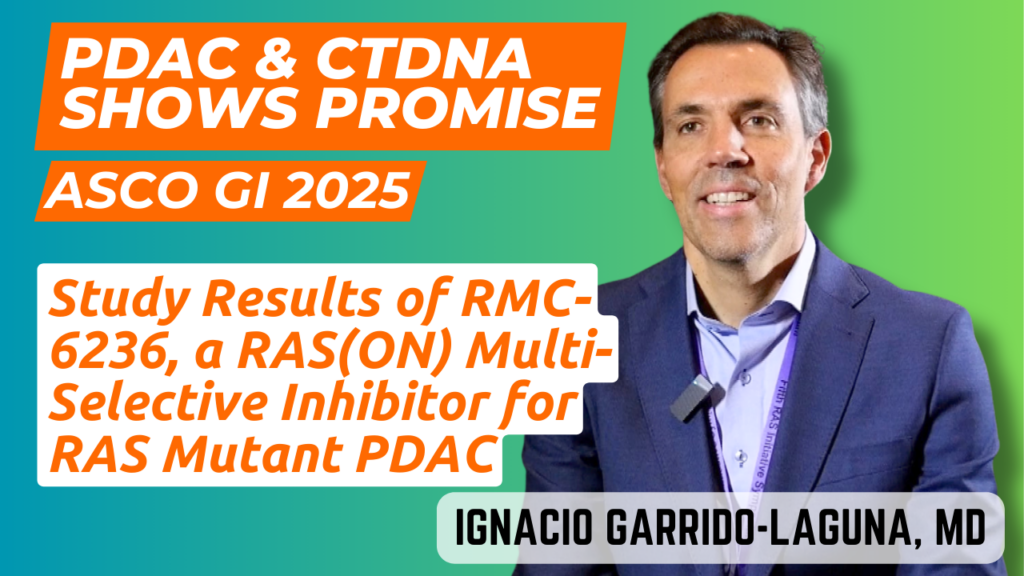
In a recent interview with Dr. Ignacio Garrido-Laguna from the University of Utah Health, we gained fascinating insights into the management of RAS mutations. Specifically, in pancreatic ductal adenocarcinoma (PDAC) and the promising results from a Phase 1 study on RMC-6236, a novel multi-selective RAS inhibitor. Here’s a comprehensive look at the discussion and the latest clinical data from the study.
Key Discussion Points:
Dr. Garrido-Laguna began by highlighting the prevalence of RAS mutations in PDAC. He stated, “We do see RAS in around 90% of these patients, most of the ras that we see. It’s a low grade, grade one grade too.” This sets the stage for understanding the critical role RAS plays in this cancer type.
When it comes to managing RAS-related side effects, Dr. Garrido-Laguna explained that the approach mirrors that used for metastatic colorectal cancer patients. These patients are treated with EGFR inhibitors. He noted, “So we start preventive treatment with antibiotic, with a typically cycling twice a day. And then we also do some topical interventions, topical steroids, topical antibiotics.”
Efficacy of RMC-6236:
Dr. Garrido-Laguna shared his perspective on RMC-6236’s performance. He said, “So we think that compared to historical controls, the data I speaks for itself, like PFS around eight months. This more than duplicates the typical PFS that we see in the second line in patients with metastatic pancreatic cancer.” This suggests a significant leap in treatment outcomes for PDAC patients.
ctDNA Reduction:
Regarding the reliability of circulating tumor DNA (ctDNA) reduction as a marker for efficacy, he mentioned, “So what we can see from the data is that 90% of patients have ctDNA reductions more than 50%, right? And that there was a group of patients where we could see complete the eradication of the CTDNA close to 50% of the of the patients.” This indicates a potential biomarker for treatment response.
Data from the Phase 1 Study of RMC-6236:
The study titled “Safety, efficacy, and on-treatment circulating tumor DNA (ctDNA) changes from a phase 1 study of RMC-6236, a RAS(ON) multi-selective, tri-complex inhibitor, in patients with RAS mutant pancreatic ductal adenocarcinoma (PDAC)” provided the following insights:
- Patient Population: 127 patients with RAS mutant PDAC received RMC-6236 at doses of 160–300 mg QD.
- Safety Profile: Common adverse events included rash (91%), diarrhea (48%), nausea (43%), and others, showcasing a manageable safety profile.
- Efficacy Results:
- KRAS G12X Mutation Group (n=42): ORR was 29% (95% CI: 16–45), median PFS was 8.5 months (95% CI: 5.3–11.7), and median OS was not reached but estimated at 14.5 months.
- Other RAS Mutant Group (n=57): ORR was 25% (95% CI: 14–38), median PFS was 7.6 months (95% CI: 5.9–11.1), and median OS was also estimated at 14.5 months.
- ctDNA Response:
- KRAS G12X Mutation Group (n=56): 95% of patients showed >50% decrease in ctDNA from baseline, with 50% achieving complete eradication.
- Other RAS Mutant Group (n=68): 93% showed >50% decrease, with 47% achieving complete eradication.
Dr. Garrido-Laguna’s work and the Phase 1 study results indicate that RMC-6236 could represent a significant advancement in the treatment landscape for PDAC. This offers hope for improved survival rates and quality of life for patients with this challenging disease. The ongoing RASolute 302 Phase 3 trial will further elucidate RMC-6236’s role in the second-line setting compared to standard chemotherapy.
Stay tuned to OncologyTube.com for more updates and expert interviews on the latest in cancer research and treatment.
Timestamp: 00:00 – Introduction to RAS in Patients
00:05 – Grade Distribution of RAS 00:15 – Management of RAS Similar to Metastatic Colorectal Cancer 00:30 – Topical Interventions for RAS Management
00:45 – Common Management with Oral Antibiotics and Steroids
01:04 – Efficacy Comparison of RMC 6236
01:21 – Overall Survival Data 01:46 – Predictive Value of CTDNA Reduction
02:35 – Selection of Patients with Specific RAS Mutations
03:22 – Overview of RASolute 302 Study
#Oncology #PancreaticCancer #RMC6236 #RASmutation #ClinicalTrials #CancerResearch #PersonalizedMedicine #UniversityOfUtahHealth #IgnacioGarridoLaguna
Related Links:
https://dailynews.ascopubs.org/do/pan-ras-inhibitor-shows-early-deep-molecular-responses-pdac