


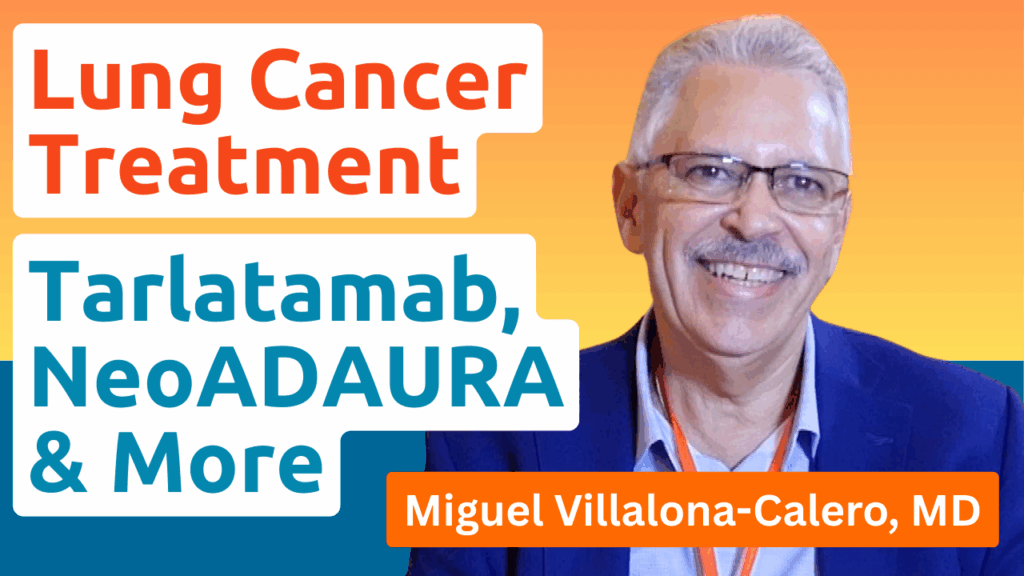
At the 2025 MOASC Spotlight in Newport Beach, CA, Dr. Miguel Villalona-Calero, MD, from the University of California Irvine, shared key ASCO 2025 lung cancer advances. His OncologyTube interview and slide deck highlight progress in small cell lung cancer (SCLC) and non-small cell lung cancer (NSCLC). For example, trials like NeoADAURA, DeLLphi-304, and KRYSTAL-7 show promise for targeted therapies and immunotherapy. These insights could transform oncology practice. These Lung Cancer ASCO 2025 Updates indicate significant strides in the field.
Watch the interview and download the slide deck for trial details from the Lung Cancer ASCO 2025 Updates.
[Embed Video: Dr. Miguel Villalona-Calero’s 2025 MOASC Spotlight Lung Cancer Interview]
[Download Slide Deck: Dr Villalona Slides REVISED.pptx]
Small Cell Lung Cancer (SCLC): New Hope for Tough Cases
SCLC is aggressive, but ASCO 2025 trials, discussed at MOASC, bring breakthroughs. Specifically, Dr. Villalona-Calero’s transcript and slides focus on maintenance and second-line therapies. The 2025 updates for lung cancer discussed at ASCO provide fresh hope for managing these tough cases.
Lurbinectedin + Atezolizumab for Maintenance
The IMforte trial, noted in the slides, shows lurbinectedin with atezolizumab boosts progression-free survival (PFS) and overall survival (OS) by 3 months. However, it increases toxicity. Thus, careful patient selection is key. This approach tackles SCLC’s rapid recurrence.
Tarlatamab: A Game-Changer for Second-Line SCLC
The DeLLphi-304 trial, a major ASCO 2025 highlight, shows tarlatamab, a DLL3-targeted antibody, extends OS by 5 months versus chemotherapy in relapsed SCLC. Dr. Miguel Villalona-Calero, MD, states: “And it has an overall survival demonstrated improvement, compared to chemotherapy” (~0:45).
Slides confirm cytokine release syndrome (CRS) and neurotoxicity (ICANS) align with tarlatamab’s safety profile. For instance, dose stepping and monitoring after initial cycles reduce severe events. Most patients continue therapy without stopping.
Slide Insight: “CRS and ICANS events were consistent with tarlatamab’s established safety profile.”
Takeaway: Tarlatamab offers a vital survival boost for second-line SCLC, another highlight from the Lung Cancer ASCO 2025 Updates.
Early-Stage NSCLC: Neoadjuvant Osimertinib Leads
Dr. Villalona-Calero’s slides (Slides 4, 8, 11) and transcript emphasize resectable NSCLC, especially for EGFR mutations, with NeoADAURA as a key trial.
NeoADAURA: Osimertinib’s Strong Results
NeoADAURA, presented at ASCO 2025, tests neoadjuvant osimertinib with or without chemotherapy in EGFR-mutant NSCLC. It achieves a major pathological response (MPR) in ~33% of patients and downstaging in ~50%. Dr. Miguel Villalona-Calero, MD, explains: “And we know that Osymartine, with or without chemotherapy, can produce a good number, maybe a third, you know, of patients, you know, can get a major pathological response, which does an advantage” (~2:15).
OS data are not yet mature. Still, these results suggest lasting benefits. The slides cite the trial’s DOI (10.1200/JCO-25-00883). While osimertinib awaits FDA approval for neoadjuvant use, immunotherapy aids PD-L1-positive, non-driver NSCLC.
Clinical Implication: The Lung Cancer ASCO 2025 Updates position osimertinib as a top option for EGFR-mutant NSCLC before surgery.
Metastatic NSCLC: Targeted Therapies Take Center Stage
The transcript and slides cover advances for EGFR exon 20, HER2, and KRAS G12C mutations in advanced NSCLC, reflecting ASCO 2025’s precision focus.
EGFR Exon 20: Zipalertinib Shines
Slides highlight zipalertinib’s success after platinum-based chemotherapy with or without amivantamab (Lee et al., npj Precis Onc 2022). This oral TKI offers a chemo-free option for EGFR exon 20 insertions.
HER2 Mutations: Oral TKIs Beat ADCs
HER2 mutations affect 3-4% of NSCLC, especially in never-smokers. Dr. Miguel Villalona-Calero, MD, notes: “So her two mutations can occurred, you know, probably in about 3, 4% known as mocelon cancer, more common in never as smokers” (~3:30). Oral TKIs like zongertinib and sevabertinib (SOHO-01, Beamion LUNG-1) achieve 60-71% response rates, surpassing ADCs like trastuzumab deruxtecan with better safety (Slide 6).
KRAS G12C: Adagrasib + Pembrolizumab Boosts Response
The KRYSTAL-7 study, detailed in slides, combines adagrasib with pembrolizumab, improving response rates (~49%) and PFS in PD-L1-high patients. Dr. Miguel Villalona-Calero, MD, says: “So for KRAS G12C mutations, we have two drugs that are if they approve, Adagasive and sooturassive. And they do produce responses, you know, in patients. However they are not long lasting. So you, six to eight months, you know, you can expect that patients are going to progress” (~4:25-4:30). Liver toxicity, managed with steroids, is a concern. Early KRAS G12D data look promising. These findings are some of the notable elements in the Lung Cancer ASCO 2025 Updates.
Slide Insight: “Response per investigator assessment in all patients; PFS according to PD-L1 status.”
Key Takeaways from 2025 MOASC Spotlight
Dr. Villalona-Calero’s ASCO 2025 insights, shared at MOASC, guide oncology practice:
- SCLC: Lurbinectedin + atezolizumab adds 3 months to PFS/OS. Tarlatamab extends OS by 5 months with manageable side effects.
- Resectable NSCLC: Osimertinib shows promise for EGFR mutations. Immunotherapy aids PD-L1-positive cases.
- Metastatic NSCLC: Zipalertinib for EGFR exon 20, zongertinib/sevabertinib for HER2, and adagrasib + pembrolizumab for KRAS G12C. KRAS G12D data are emerging.
These updates, presented at the 2025 MOASC Spotlight, highlight precision medicine’s impact on lung cancer treatments and are part of the broader Lung Cancer ASCO 2025 Updates.