


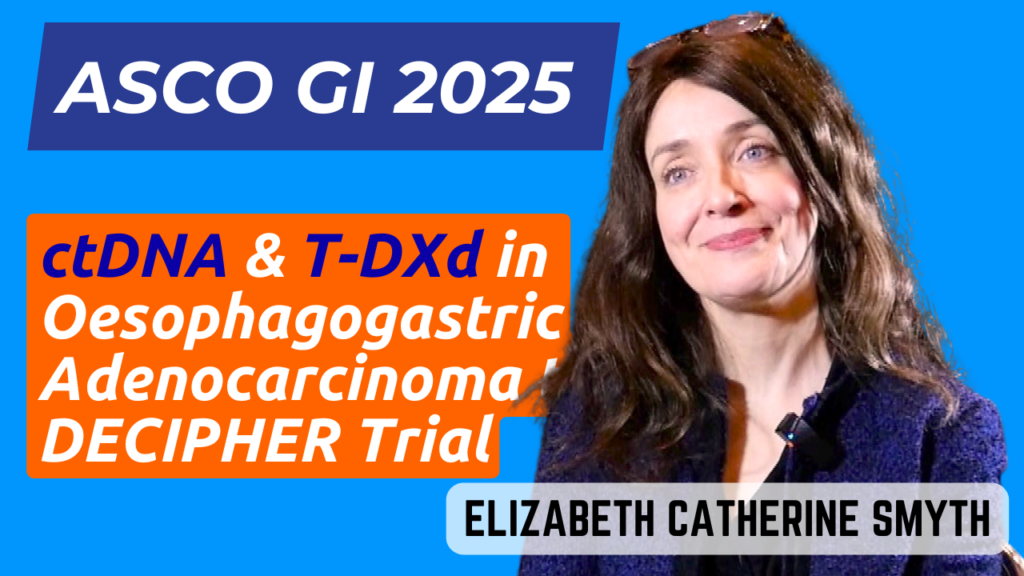
By: Elizabeth Catherine Smyth – Cambridge University Hospitals NHS Foundation Trust
Background: Oesophagogastric adenocarcinoma (OGA) remains a significant global health challenge, often diagnosed at an advanced stage where curative treatment with multimodality therapy is less than 50% effective. In the UK, the standard of care for operable OGA includes FLOT chemotherapy before and after surgery. However, patients with detectable circulating tumor DNA (ctDNA) post-surgery face poorer survival outcomes, indicating the presence of micrometastatic disease. This scenario necessitates innovative approaches beyond conventional therapies. Trastuzumab deruxtecan (T-DXd), an antibody-drug conjugate targeting HER2, has shown promise in treating advanced, previously treated HER2-positive OGA, prompting the need to assess its efficacy in the adjuvant setting for those with both HER2 and ctDNA positivity.
The DECIPHER Trial: Launched in April 2024, the DECIPHER trial is a pioneering phase II study coordinated by the Cancer Research UK Southampton Clinical Trials Unit. This single-arm, multicenter study aims to evaluate the impact of T-DXd on reducing the burden of micrometastatic disease in patients with HER2-positive OGA who are ctDNA positive following chemotherapy and surgery. Eligible patients must have undergone at least six weeks of preoperative chemotherapy and be free from metastatic disease post-surgery as confirmed by imaging.
Study Details:
- Intervention: Patients receive T-DXd at 6.4 mg/kg every 21 days for up to 8 cycles or until disease recurrence, with dose reduction options but no re-escalation.
- Primary Endpoint: The percentage of patients who become ctDNA negative after 4 cycles of treatment.
- Secondary Endpoints: Include ctDNA clearance after each cycle, disease-free survival, overall survival, quality of life, and adverse event frequency.
- ctDNA Testing: Utilizes the Signatera assay by Natera, Inc., a clinically validated, personalized, tumor-informed ctDNA test.
Insights from the Transcript: The trial represents one of the initial forays into using positive ctDNA as a criterion for selecting patients for adjuvant therapy, specifically looking to identify a signal of efficacy among this high-risk group. The approach with T-DXd or similar treatments aims to reduce ctDNA levels, which could correlate with improved survival rates. The study builds on previous work, such as the Occums retrospective analysis from Cambridge, but uses more advanced technology like whole genome sequencing and methylation-based assays for greater sensitivity and reliability in detecting ctDNA.
Current Status: DECIPHER has begun recruiting across approximately 15 UK hospitals, with 27 patients already enrolled in the tissue testing phase as of September 23, 2024, aiming to gather data from 25 evaluable patients.
Implications: This trial could redefine treatment paradigms for OGA by offering a targeted therapy option for those with residual disease post-surgery, potentially leading to better survival outcomes and quality of life. It also underscores the importance of ctDNA in guiding treatment decisions, highlighting a shift towards personalized medicine in oncology.
Conclusion: The DECIPHER trial is not just an exploration into the efficacy of T-DXd in a specific subset of OGA patients but also a step forward in understanding the role of ctDNA in cancer management. As we await the results, the oncology community watches closely, hopeful for a breakthrough that could extend and enhance the lives of those affected by this aggressive cancer.
Related Articles: