


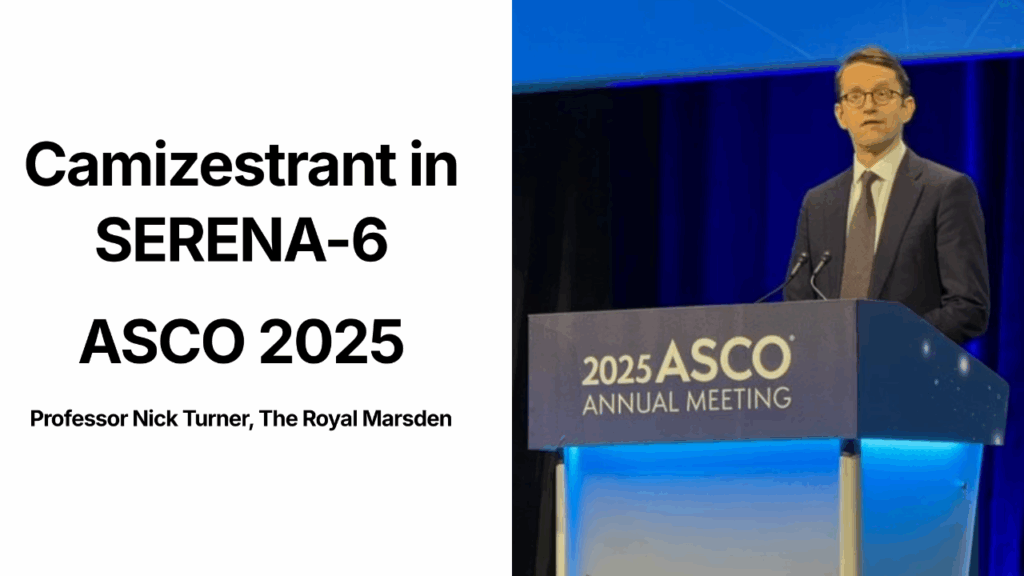
The Camizestrant SERENA-6 trial shone at ASCO 2025, presented by Professor Nick Turner. This Phase 3 study targets ESR1-mutated, ER-positive, HER2-negative breast cancer. It shows better progression-free survival (PFS) for patients, as reported in the New England Journal of Medicine. Let’s explore the trial’s key findings.
What is the Camizestrant SERENA-6 Trial?
The SERENA-6 trial, funded by AstraZeneca, tests camizestrant’s effectiveness. It focuses on ESR1 mutations, which resist standard breast cancer treatments. Camizestrant, a next-generation SERD, blocks estrogen receptors completely. Thus, it offers a new way to fight resistant tumors.
Trial Design
The trial screened 3,256 patients for ESR1 mutations using ctDNA tests every 2–3 months. Consequently, 315 patients were assigned to two groups. All had at least 6 months of prior treatment with aromatase inhibitors (AIs) and CDK4/6 inhibitors. The groups were:
- Camizestrant group (157 patients): Switched to camizestrant (75 mg daily) plus CDK4/6 inhibitor.
- AI group (158 patients): Continued AI plus CDK4/6 inhibitor.
This design, as Turner shared at ASCO 2025, ensures reliable results.
Key Results from SERENA-6
The Camizestrant SERENA-6 trial delivered strong results. It improved PFS and quality of life (QoL) significantly.
PFS Outcomes
After 12.6 months of follow-up, camizestrant extended PFS to 16.0 months (95% CI, 12.7–18.2). The AI group reached 9.2 months (95% CI, 7.2–9.5). This 6.9-month gain had a hazard ratio (HR) of 0.44 (P<0.0001). Therefore, camizestrant shows clear benefits.
SERENA-6 trial, showing 16.0 vs. 9.2 months PFS.
Quality of Life
Camizestrant patients maintained QoL for 23.0 months, compared to 6.4 months for the AI group (HR 0.53). For example, this means better daily life for patients. This result matters greatly to those facing treatment.
Safety Profile
Only 1.3% of camizestrant patients stopped due to side effects, versus 1.9% in the AI group. Thus, camizestrant is well-tolerated, making it practical for clinical use.
What Does This Mean for Breast Cancer?
At ASCO 2025, Professor Turner, from The Royal Marsden, highlighted the PFS gain. However, a June 1, 2025, tweet noted that long-term survival data is still needed. Despite this, camizestrant could change treatment for ESR1-mutated breast cancer.
For doctors and researchers, the trial’s ctDNA approach and strong data (HR 0.44) guide precision medicine. Patients gain hope from better QoL and fewer side effects. Additionally, these findings encourage further research.
References:
New England Journal of Medicine Article:
- URL: https://doi.org/10.1056/NEJMoa2502929
- Description: This is the primary source for the SERENA-6 trial data, published on June 1, 2025, by François-Clément Bidard, Erica L. Mayer, and others. It provides detailed trial design, results (PFS: 16.0 vs. 9.2 months, HR 0.44, P<0.0001; QoL: 23.0 vs. 6.4 months, HR 0.53; discontinuation: 1.3% vs. 1.9%), and conclusions, as cited in the web post and script.
ClinicalTrials.gov Registry:
- URL: https://clinicaltrials.gov/ct2/show/NCT04964934
- Description: This is the official registry for the SERENA-6 trial (NCT04964934), funded by AstraZeneca. It confirms trial details, including the screening of 3,256 patients, randomization of 315, and the use of camizestrant (75 mg daily) with CDK4/6 inhibitors, as referenced in the materials.
Related Links: