


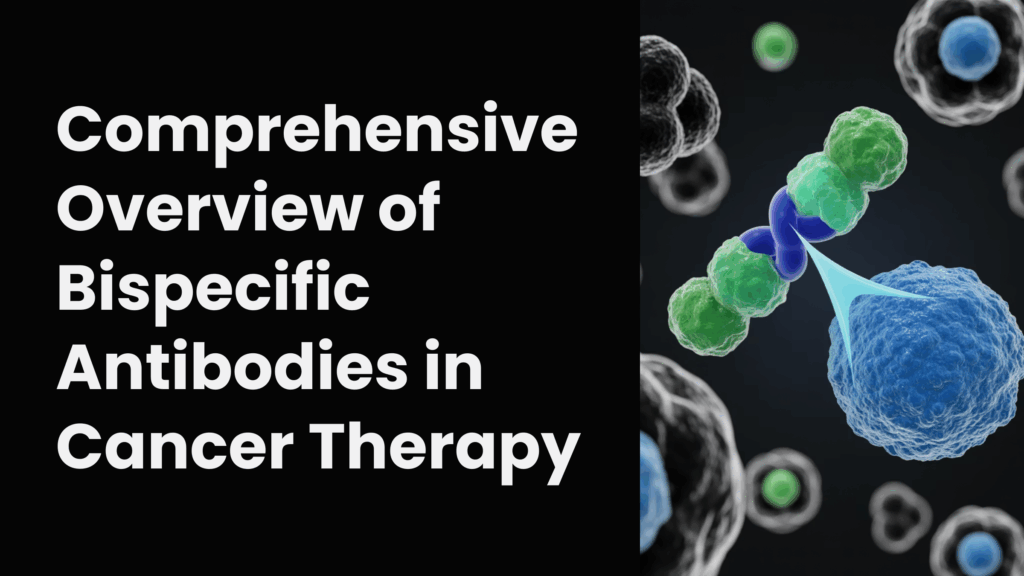
Welcome to this exclusive OncologyTube.com companion to our video, “Comprehensive Overview of Bispecific Antibodies in Cancer Therapy.” Bispecific antibodies (bsAbs) are transforming cancer immunotherapy 2025 by targeting two antigens to boost tumor destruction. This post, inspired by Klein et al. (2024) in Nature Reviews Drug Discovery, offers deep insights into clinical data, trials, and future trends in bsAb oncology. Whether you’re an oncologist or researcher, this guide provides valuable takeaways.
What Are Bispecific Antibodies?
Firstly, bispecific antibodies are innovative molecules that bind two targets, such as CD3 on T cells and CD19 on cancer cells. This dual action redirects the immune system to attack tumors precisely. For instance, Blinatumomab, a CD19×CD3 BiTE, links T cells to B-cell acute lymphoblastic leukemia (ALL) cells. Moreover, the Nature Reviews article explains how bsAbs overcome limits of traditional antibodies, making them key to bispecific antibodies cancer therapy.
- Key Mechanism: Immune cell engagement with tumor cells.
- Example: Blinatumomab’s 69% minimal residual disease (MRD) negativity in relapsed ALL (Blood, 2018).
Approved BsAbs and Clinical Successes
Next, as of 2023, 11 bsAbs have gained approval, with more emerging in 2025. These therapies show impressive results in trials:
- Blinatumomab: Achieved 43% complete remission in relapsed/refractory ALL (NEJM, 2017).
- Tebentafusp: Boosted 1-year survival to 31% in metastatic uveal melanoma (NEJM, 2021).
- Elranatamab: Delivered a 60% response rate in relapsed/refractory multiple myeloma (Nature Medicine, 2023).
Therefore, these outcomes highlight bsAbs’ potential in bsAb oncology, offering hope for tough cancers. The video updates these milestones with 2025 data.
Diverse Mechanisms and Formats
Additionally, bsAbs come in varied formats, each suited to specific cancers:
- BiTEs: Small molecules like Blinatumomab.
- IgG-like BsAbs: Larger structures like Amivantamab, targeting EGFR and MET in NSCLC (J Biol Chem, 2021).
- Trispecific BsAbs: New designs with three targets for better efficacy.
Furthermore, the Nature Reviews Fig. 1 shows these structures, proving how format shapes action in bispecific antibodies cancer therapy.
T-Cell and Innate Immune Engagers
Moreover, T-cell engagers like Blinatumomab have changed hematologic cancer care, with 69% MRD negativity in phase 2 trials (Blood, 2018). Similarly, innate immune engagers, such as AFM13 (CD30×CD16A), enhance NK cell activity, achieving a 50% response in phase 1 Hodgkin lymphoma trials (Blood, 2020). Consequently, these advances strengthen bsAbs’ role in cancer immunotherapy 2025.
Checkpoint Inhibitors and Dual Blockade
Also, checkpoint inhibitors like Cadonilimab (PD-1×CTLA-4) offer dual blockade, boosting T-cell activity. Phase 2 trials reported a 30% response rate in advanced NSCLC (Lancet Oncology, 2023). Thus, this approach enhances existing therapies in bsAb oncology.
Overcoming Challenges with Prodrugs
In addition, off-tumor toxicity and antigen escape challenge bsAb use. Prodrugs like TAK-186 tackle this, cutting toxicity by 70% via TME activation (Journal of Immunotherapy Cancer, 2022). Hence, this innovation improves safety in bispecific antibodies cancer therapy for 2025.
Future Innovations and 2025 Trends
Finally, the future includes:
- Trispecific BsAbs: Targeting multiple antigens for solid tumors.
- Cytokine Mimetics: IL-2 mimetics boost T-cell function (Nature, 2019).
- AI-Driven Design: Speeds development, with tools like Generate (LabBiotech.eu, March 2025).
For example, Tarlatamab, a DLL3×CD3 bsAb, showed a 25% response rate in SCLC in 2025 phase 2 trials (NEJM, 2023). These trends shape cancer immunotherapy 2025.
Integrating BsAbs into Clinical Practice
Likewise, bsAbs integrate with CAR-T therapy and PD-1 inhibitors. Elranatamab’s 60% response in myeloma (Nature Medicine, 2023) suggests a protocol shift. So, these combinations transform bsAb oncology workflows.
Conclusion and Next Steps
In summary, bispecific antibodies lead bispecific antibodies cancer therapy, backed by solid data and new designs. For more, check the Nature Reviews article (https://www.nature.com/articles/s41573-024-00896-6) and our web companion with full references.
Share This Post: Spread the knowledge!
Subscribe: Join OncologyTube.com for more cancer topics.
Learn More: Visit OncologyTube.com for resources.