


Published: February 2, 2026
Author: Dr. Brian Sworder, MD | City of Hope
Category: ASH 2025 | Lymphoma | Precision Oncology | MOASCThis article covers some of the ASH 2025 lymphoma highlights of most interest to clinicians and researchers.
Watch the Full Expert Interview:
Key Takeaways from ASH 2025 Lymphoma Highlights
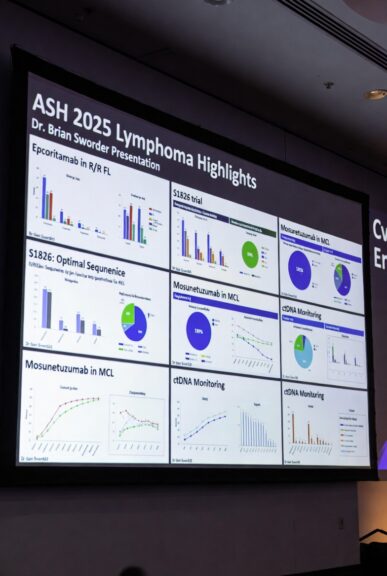
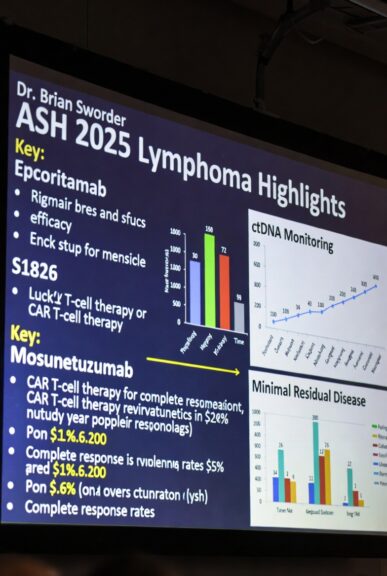
The 67th American Society of Hematology (ASH) Annual Meeting delivered several practice-changing updates in lymphoma care. For example, in this exclusive interview, Dr. Brian Sworder reviews four major areas. First, epcoritamab combined with lenalidomide and rituximab shows promise in relapsed/refractory follicular lymphoma. Next, the S1826 trial’s 3-year results strengthen nivolumab-AVD as a frontline option in classical Hodgkin lymphoma. Moreover, mosunetuzumab emerges as a chemotherapy-sparing choice for older or frail patients with newly diagnosed DLBCL. Finally, circulating tumor DNA (ctDNA) enables earlier relapse detection and better risk stratification in large B-cell lymphoma.

As a result, these insights help clinicians adopt targeted, less toxic strategies. Below, the most important clinical messages are explained in plain language.
1. Epcoritamab + R² – A New Standard for Relapsed Follicular Lymphoma?
What Dr. Sworder said: “Adding epcoritamab, which is a CD20 × CD3 bispecific antibody… engages T cells to attack lymphoma cells. Therefore, the advantage is that it increases the depth of response… and consequently results in deeper responses and hopefully more durable remissions.”
Key data (EPCORE FL-1 phase 3 trial – Lancet 2025 & ASH 2025 presentation)
| Endpoint | Epcoritamab + R² | Lenalidomide + Rituximab (R²) | Difference / HR |
|---|---|---|---|
| Overall Response Rate (ORR) | ~95% | ~79% | +16% |
| Complete Response Rate (CR) | ~83% | ~50% | +33% |
| 16-month PFS | 85.5% (95% CI 79.7–89.7) | 40.2% (95% CI 31.8–48.4) | HR 0.21 (79% risk reduction) |
| Median PFS | Not reached | ~11–12 months | — |
| Overall Survival trend | 95.8% at 16 months | 88.8% at 16 months | Positive trend |
Why it matters: In addition, this fixed-duration, chemotherapy-free regimen offers manageable outpatient toxicity (mainly low-grade CRS and neutropenia). Furthermore, benefits were observed across high-risk subgroups, including POD24 patients. Therefore, epcoritamab + R² is poised to become a new standard in the 2L+ setting.
2. S1826 3-Year Update – Nivolumab-AVD Becomes Preferred Frontline Therapy in Advanced Hodgkin Lymphoma
What Dr. Sworder said: “The three-year follow-up… confirms that this should be the frontline regimen… Moreover, it is even more effective in older patients because it’s often kind of a less toxic regimen that older patients would be able to tolerate.”
Key findings (ASH 2025 presentation)
- Sustained PFS superiority of nivolumab + AVD over brentuximab vedotin + AVD (HR ≈ 0.5–0.6)
- In particular, greater absolute benefit in patients ≥60 years
- Lower toxicity profile compared with BV-AVD
- Overall survival data still maturing, however early trend favors nivolumab arm
Kaplan-Meier curves from related real-world data illustrating the PFS benefit of anti-PD-1 + AVD regimens in Hodgkin lymphoma – consistent with S1826 trends.
Clinical implication: Consequently, nivolumab-AVD is now widely considered the new standard of care for newly diagnosed advanced-stage (III/IV) classical Hodgkin lymphoma, especially for older adults who historically tolerate intensive regimens poorly.
3. Mosunetuzumab – Promising Chemotherapy-Sparing Option for Older or Frail DLBCL Patients
What Dr. Sworder said: “There is data that suggests that instead of using chemotherapy, if we can use some of these newer treatments like mosunetuzumab… they may be less toxic and… allow us to have less toxicity with hopefully as good or something close to as good of a response.”
Selected ASH 2025 data points
| Study / Population | Treatment | ORR | CR Rate | Median CR Duration | Key Safety Notes |
|---|---|---|---|---|---|
| MorningSun – Elderly/unfit untreated DLBCL | Mosunetuzumab monotherapy | 56% | 43% | 15.8 months | 5% G1 CRS, 7.5% G2 CRS, no G3–5 CRS |
| Mosunetuzumab + Polatuzumab | Combination | 55% | 45% | — | Manageable CRS (mostly G1–2) |
Overview table of FDA-approved bispecific antibodies (including mosunetuzumab and epcoritamab) for relapsed/refractory FL and DLBCL – highlighting their growing role in lymphoma care.
Why this matters: For instance, roughly 50% of patients ≥65–70 years with DLBCL are classified as unfit or frail using simplified geriatric assessments. As a result, high-dose R-CHOP or similar regimens carry substantial toxicity risk. Therefore, bispecific antibodies provide a meaningful alternative with lower toxicity and durable complete responses in many patients.
4. ctDNA Monitoring – Earlier Relapse Detection and Improved Risk Stratification
What Dr. Sworder said: “Circulating tumor DNA… can detect at a much lower level than traditional response assessments like PET scans and CT scans… Thus, by detecting residual disease earlier, we can act earlier… and ultimately improve their outcomes.”
Major messages from ASH 2025 (Abstract #474 & related presentations)
- On-treatment clearance
- MRD negativity at cycle 2 day 1 → extremely low relapse risk (0% relapse at 3-year landmark in one cohort)
- End-of-therapy (EOT) assessment
- Detects ~75% of early relapses (≤12 months)
- Surveillance phase
- In addition, adding periodic post-EOT samples increases detection of late relapses to ~91%
- For example, a single negative test → 97% chance of remaining relapse-free at 12 months
- Conversely, a single positive test → relapse risk rises from ~27% (6 months) to ~79% (30 months)
Diagram illustrating how ctDNA is shed from tumor cells into the bloodstream, enabling non-invasive monitoring for minimal residual disease and relapse in lymphoma patients.
Practical takeaway: Consequently, serial ctDNA monitoring (especially with ultrasensitive assays such as PhasED-Seq) is emerging as a powerful tool for both risk-adapted therapy and post-remission surveillance.
Summary – What Will Change Practice After ASH 2025?
| Disease Setting | Key Advance at ASH 2025 | Likely Practice Impact |
|---|---|---|
| Relapsed Follicular Lymphoma | Epcoritamab + R² (fixed-duration, chemo-free) | Becoming new standard in 2L+ setting |
| Advanced Hodgkin Lymphoma | Nivolumab-AVD superior & better tolerated in older adults | Preferred frontline regimen |
| Older/Frail Newly Diagnosed DLBCL | Mosunetuzumab ± polatuzumab – lower toxicity, good responses | Increasing use as alternative to R-miniCHOP |
| Large B-cell Lymphoma – Relapse Monitoring | ctDNA more sensitive than PET/CT for MRD & surveillance | Earlier intervention & potential therapy adaptation |
In summary, these ASH 2025 lymphoma highlights demonstrate a clear shift toward targeted, less toxic therapies. Therefore, clinicians can now better tailor treatment while improving outcomes for diverse patient populations.
Stay Updated
Subscribe to Oncology Tube for more ASH 2025 coverage, expert interviews, and practice-changing data summaries.
Have questions about implementing these therapies in your clinic? Leave a comment below – we’d love to hear from you.
Tags: ASH 2025, lymphoma updates, follicular lymphoma, Hodgkin lymphoma, DLBCL, bispecific antibodies, ctDNA, MRD monitoring, epcoritamab, nivolumab, mosunetuzumab, Brian Sworder
Internal links:
External links:
Bio Link Brian Sworder, MD: https://www.cityofhope.org/patients/find-a-doctor/brian-sworder