

Paraneoplastic syndromes can signal hidden cancers. Dr. Nirja Shah, MD, from UC San Diego Health, shared a rare case study. She presented at the MOASC Spotlight 2025 in Newport Beach, CA. Her interview showed how anti-Yo antibodies uncovered bilateral breast cancer. This case links neurology and oncology. Now, let’s dive into the details.
Patient Presentation: First Symptoms
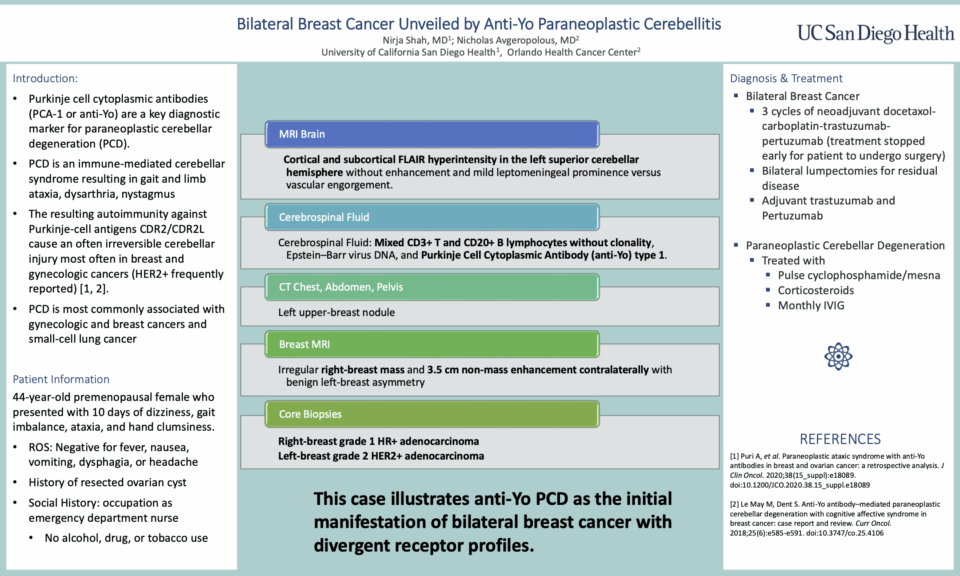
A 44-year-old nurse visited the emergency room. She had dizziness, unsteadiness, and clumsy hands for 10 days. Dr. Shah said, “She came into the emergency department with a 10-day history of ataxia, clumsiness, and dizziness.” She had no fever or nausea. Her past included a removed ovarian cyst. She avoided alcohol, drugs, and tobacco.
Diagnostic Journey: Finding the Answer
Doctors started with a brain scan. The MRI showed inflammation in the left cerebellar area. Next, they checked her spinal fluid. Dr. Shah noted, “With this anti-Yo finding in the CSF, we ended up scanning her… because anti-Yo antibodies are associated with both breast and gynecologic cancer, specifically ovarian cancer.” This prompted body scans. Results showed:
- A nodule in the left breast.
- An irregular mass in the right breast.
- Tissue checks confirmed HR+ cancer on the right and HER2+ on the left.
Dr. Shah felt surprised. She stated, “I was really surprised to see that she had a divergent kind of receptor profile for her bilateral breast cancer. So one breast had HER2 positive cancer, and the other breast was hormone receptor positive. I’ve really not seen much of that.” This rare mix guided the next steps.
Treatment and Management: Two-Part Plan
The team tackled both cancer and nerve issues. For the breast cancer:
- Doctors began three chemo cycles. They used docetaxel and trastuzumab. They stopped early for surgery.
- Surgeons removed tumors with lumpectomies.
- Trastuzumab continued after surgery.
For the nerve problem:
- The team gave cyclophosphamide, steroids, and IVIG.
Dr. Shah learned a key point. She explained, “What I learned from this case is that in a patient with subacute cerebellar degeneration, particularly women, it’s important to consider sending out a paraneoplastic panel and looking for any underlying malignancy. In this case, she ended up having breast cancer that was found only after an initial presentation of subacute cerebellar degeneration.” Early tests made a difference.
Why This Case Study Matters
This case study shows anti-Yo PCD as the first sign of bilateral breast cancer. The different tumor types are uncommon. Quick tests can spot hidden cancers. Early care may help outcomes.
Plain Terms: Unsteadiness (ataxia), tissue check (biopsies), antibody test (paraneoplastic panel) Author Bio: Dr. Nirja Shah, MD, is a resident at UC San Diego Health, focused on oncology and neurology. Profile